


The plot in the previous section shows that actually all of the
water cannot be processed in finite time. This because
 is never equal to 1 for finite t, and hence
 can never, for finite time
 , equal
 . Theoretically, we would
have to wait forever to process each and every molecule of water. It is
possible, however, to determine a time
which makes the amount of
water that goes unprocessed an arbitrarily small proportion of total
volume. Therefore, to calculate turn-over time, we ask the question: how
long will it take for 99.9 % of all tank water to be processed? Formula (9)
enables us to quickly answer this question.
. Theoretically, we would
have to wait forever to process each and every molecule of water. It is
possible, however, to determine a time
which makes the amount of
water that goes unprocessed an arbitrarily small proportion of total
volume. Therefore, to calculate turn-over time, we ask the question: how
long will it take for 99.9 % of all tank water to be processed? Formula (9)
enables us to quickly answer this question.
So how much time will it take to process
 % of the water moves through the device? We
can answer this question by determining the value of
when
% of the water moves through the device? We
can answer this question by determining the value of
when
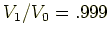 . Observe that for all
,
. Observe that for all
,
 |
(10) |
, say  , that makes
 .
A little algebra shows that
is chosen so that
.
A little algebra shows that
is chosen so that
 .
.
 of
tank water will have been processed after the device has run a time of
hours
or more. This time is defined as the
turn-over time for the device. It indicates the amount of time it takes
to circulate most all tank water through the device.
of
tank water will have been processed after the device has run a time of
hours
or more. This time is defined as the
turn-over time for the device. It indicates the amount of time it takes
to circulate most all tank water through the device.
of the tank
water has been filtered?
 gallons
per hour
and
gallons
per hour
and  gallons, to find that after an elapsed time of
 of the water will be filtered. Thus, after about 14 hours of running the
filter, only
of the water will be filtered. Thus, after about 14 hours of running the
filter, only
 of a gallon, or less than a pint of water,
will remain unfiltered.
of a gallon, or less than a pint of water,
will remain unfiltered.
