The derivation of a formula for
 for
for  larger than 1 is quite similar
to the derivation of
larger than 1 is quite similar
to the derivation of
 . Already it has been observed that
must satisfy.
A differential equation can be derived in a manner similar to the derivation
of (6). Observe that the volume of water that has been processed
exactly  times is (
 ). That is, the volume of water that has
been processed exactly
times is equal to the volume of water
that has been processed
or more times minus that volume
that has been processed
or more times.
). That is, the volume of water that has
been processed exactly
times is equal to the volume of water
that has been processed
or more times minus that volume
that has been processed
or more times.
It follows then that
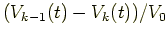 represents the fraction of tank water
that, at any particular instant in time
represents the fraction of tank water
that, at any particular instant in time
 , can possibly be converted to water that
has been processed times. Therefore, the rate of change of
is just the
flow rate
, can possibly be converted to water that
has been processed times. Therefore, the rate of change of
is just the
flow rate  scaled by this fraction
:
scaled by this fraction
:

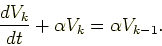
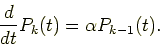
 , we find that
Observe that (13) and (12) reduce to equations
(6) and (7) when
 . We have already shown that
 . Now we find
for
. Now we find
for
 .
.
Define the polynomial
 |
(14) |
 |
(15) |
 |
(16) |
 , so that
 satisfies equation (12).
It follows that
satisfies equation (12).
It follows that
 |
 |
![$\displaystyle [-\alpha P_{k-2} e^{-\alpha t} + \alpha P_{k-1} e^{-\alpha t}] V_0$](img72.gif) |
|
 |
 |
![$\displaystyle +[\alpha - \alpha P_{k-1} e^{-\alpha t}] V_0$](img75.gif) |
|
|
|
 |
satisfies the initial condition (12) and the differential equation
(13),
 , and hence