 The Scout: Friend or Foes?. American: Frederic Remington (1861-1909) The artist is a famous chronicler of the American West, despite the fact that he spent most of his adult life living and woking in New York and Connecticut. He made many visits to the West, drawing and photgraphing details of life in the territories. |
 Saco Bay. American: Winslow Homer (1836-1910) 1896. Oil on canvas. Homer painted this sunset over Saco Bay in Maine from a spot near his studio. Two women, carrying fishing nets and lobster traps, seem as solid and enduring as the rocks beneath their feet. They were among the last figures Homer included in his paintings, as he increasingly turned his attention to the sea. One contemporary reviewer criticized the scene's "unnatural strawberry sky", but the artist considered it one of his best works. |
 Undertow. American: Winslow Homer (1836-1910) Homer based "Undertow" on a real event, a rescue he had witnessed at the New Jersey Shore. Two women, wearing voluminous bathing costumes, have been engulfed by an unexpected wave while taking the sea air. Their wet clothes weighed them down as their rescuers attept to drag them to safety. |
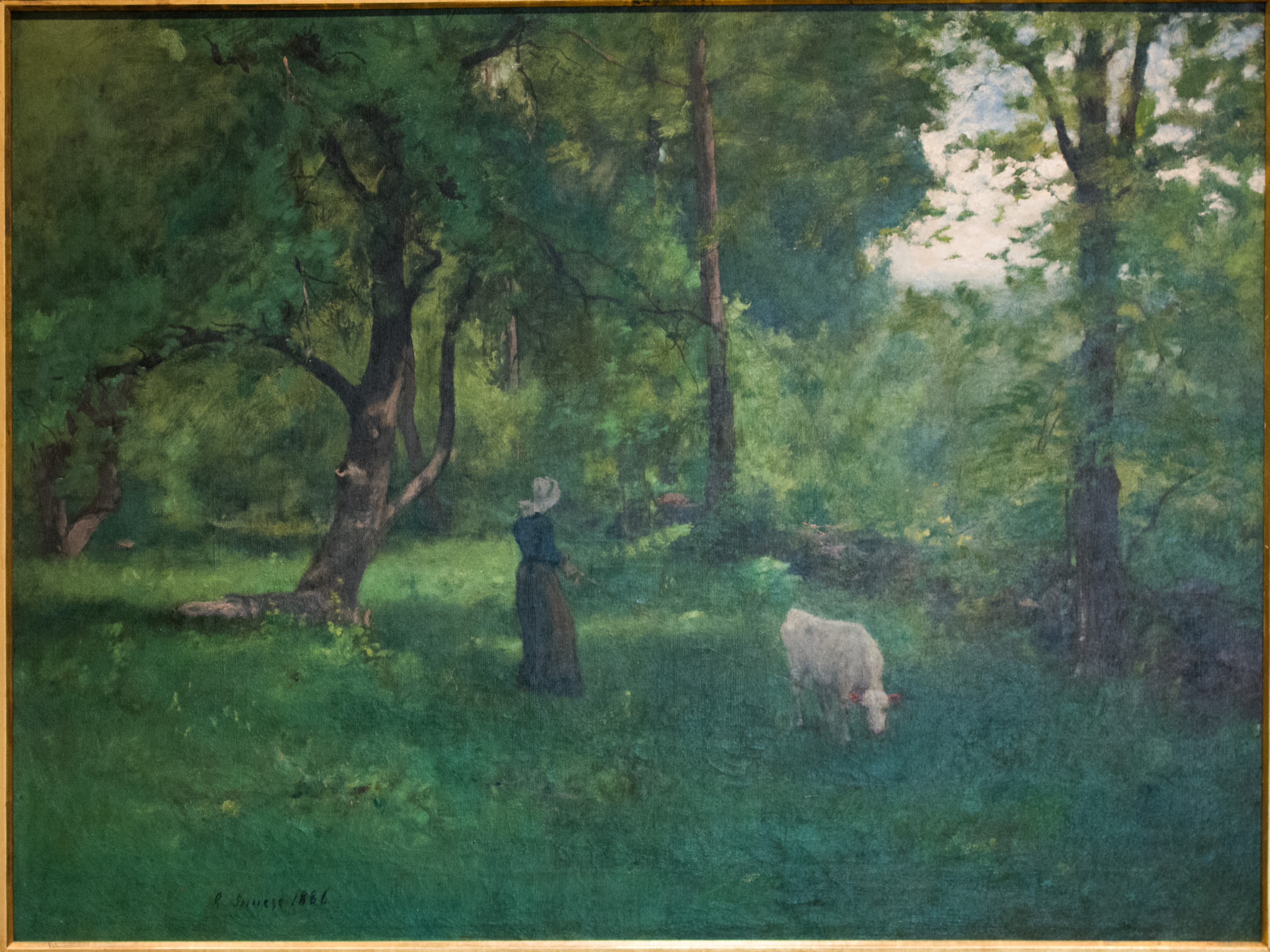 Green Landscape. American: George Inness (1825-1894) 1886. Oil on Canvas. While working on this landscape, Inness shifted the female figure, originally positioned in the middle of the canvas, farther to the left. In the finished work, the shepherdess and grazing calf are perfectly balanced on either side of the vertical line of the central tree. This subtle adjustment typifies the care Inness took to enhance what he called the "great spiritual principle of harmony" in his compositions. |
 A Pastoral. American: George Inness (1825-1894) 1882 - 85. Oil on Canvas. A boy in a skiff drives cattle along a stream while a young woman in white appears on a path in the distance. This ethereal female figure, painted with thin layers of translucent color, contrasts with the everyday reality of the cowherd and his livestock. |
 Scene at Durham, an Idyll. American: George Inness (1825-1894) 1882 - 85. Oil on Canvas. Inness often worked on his paintings over extended periods. He started this painting in 1882, making changes to the composition and the color over the next three years. The artist altered the time of day from early to late afternoon by adding orange to the horizon, darkening the rocky ledge, and deepening the shadows in the foliage. |
 The Thinker. French: Francois-Auguste-Rene Rodin (12 November 1840 - 17 November 1917), known as Auguste Rodin was a French sculptor. Although Rodin is generally considered the progenitor of modern sculpture, he did not set out to rebel against the past. He was schooled traditionally, took a craftsman-like approach to his work, and desired academic recognition, although he was never accepted into Paris's foremost school of art. Sculpturally, Rodin possessed a unique ability to model a complex, turbulent, deeply pocketed surface in clay. Many of his most notable sculptures were roundly criticized during his lifetime. They clashed with the predominant figure sculpture tradition, in which works were decorative, formulaic, or highly thematic. Rodin's most original work departed from traditional themes of mythology and allegory, modeled the human body with realism, and celebrated individual character and physicality. Rodin was sensitive to the controversy surrounding his work, but refused to change his style. Successive works brought increasing favor from the government and the artistic community. |
 The Thinker. French: Francois-Auguste-Rene Rodin (12 November 1840 - 17 November 1917), known as Auguste Rodin was a French sculptor. Although Rodin is generally considered the progenitor of modern sculpture, he did not set out to rebel against the past. He was schooled traditionally, took a craftsman-like approach to his work, and desired academic recognition, although he was never accepted into Paris's foremost school of art. Sculpturally, Rodin possessed a unique ability to model a complex, turbulent, deeply pocketed surface in clay. Many of his most notable sculptures were roundly criticized during his lifetime. They clashed with the predominant figure sculpture tradition, in which works were decorative, formulaic, or highly thematic. Rodin's most original work departed from traditional themes of mythology and allegory, modeled the human body with realism, and celebrated individual character and physicality. Rodin was sensitive to the controversy surrounding his work, but refused to change his style. Successive works brought increasing favor from the government and the artistic community. |
 Child with a Bird. French: Pierre-Aguste Renoir (1841-1919) 1882. Oil on canvas. Renoir painted this young girl during a visit to Algeria, then a French colony. The sitter, Mademoiselle Fleury, was probably French, but she is shown wearing what the artist described as an "Algerian costume." While her dress and the setting are meant to evoke North Africa, the theme of young women holding birds was popular in eighteenth- and nineteenth-century European paintings. Renoir exhibited this work as Child with a Bird, suggesting the image functioned both as a portrait and a genre scene. |